

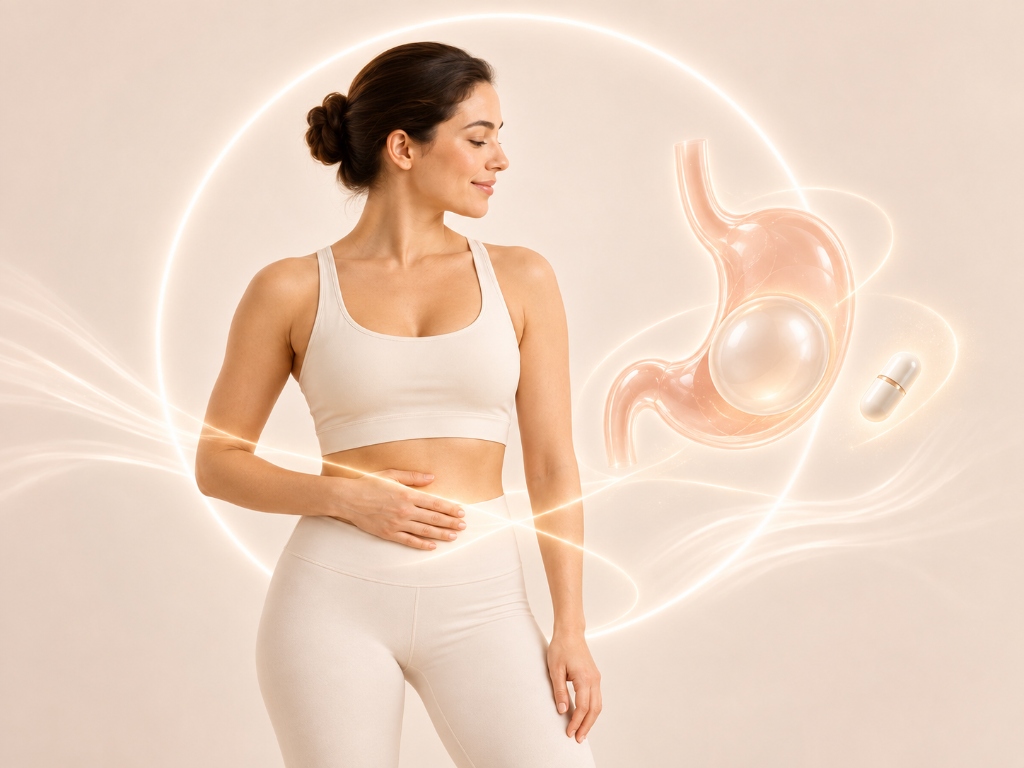
Considering a gastric balloon in Dubai, but unsure whether to choose an endoscopic balloon or a swallowable capsule balloon? The main differences are how the balloon enters and leaves the stomach, how long it stays in place, and the clinical care involved.
A capsule balloon is itself a type of gastric balloon. In this clinical guide, “gastric balloon” refers to the traditional endoscopic option, while “capsule balloon” refers to the swallowable Allurion system. Neither is automatically better for everyone: the right choice always begins with an individualized medical assessment.
What is a gastric balloon?
A gastric balloon is a temporary medical device placed inside the stomach to take up space, helping you feel full sooner and comfortably consume smaller portions. Unlike bariatric surgeries (such as sleeve gastrectomy or gastric bypass), it does not involve cutting, stapling, or permanently removing any part of your stomach. For lasting metabolic success, balloon treatment should always be combined with tailored dietary modifications, supervised physical activity, and ongoing clinical support. [1]
How does a capsule balloon work?
The Allurion capsule system contains a deflated, soft balloon folded inside a vegetarian capsule attached to a micro-catheter tube. A licensed healthcare professional supervises the placement in a simple outpatient setting. The patient swallows the capsule with a glass of water, and an X-ray verifies its exact position in the stomach before it is filled with 550ml of sterile fluid.
Routine placement requires no endoscopy, no sedation, and no surgery. After approximately 16 weeks (around 4 months), a time-activated release valve opens, allowing the balloon to safely empty its fluid and pass naturally through the digestive tract. On rare occasions, if spontaneous passage does not occur or symptoms arise, endoscopic intervention may be necessary. [2]
How does an endoscopic balloon work?
For a traditional endoscopic gastric balloon, a specialist physician uses a high-definition flexible camera (endoscope) gently guided through the esophagus into the stomach while you are under mild intravenous sedation or light anesthesia. The balloon is precisely positioned and inflated under direct visual monitoring.
At the conclusion of the treatment period, the balloon is punctured, deflated, and gently extracted through the mouth during a second brief endoscopic procedure. Treatment duration depends entirely on the device: standard models are designed for 6 months, while certain adjustable models permit placement up to 12 months under approved clinical instructions. [3] [4]
Always ask your specialist which exact device model is being recommended and its mandatory removal timeline. A balloon approved for 6 months must never be left in place for a full year, as extended duration risks acid degradation and complications. [3]
Gastric balloon vs capsule balloon: key differences
Here is a direct side-by-side comparison of endoscopic intragastric balloons and the Allurion swallowable capsule balloon:
| Feature | Endoscopic Gastric Balloon | Allurion Capsule Balloon |
|---|---|---|
| Placement Method | Through the mouth using a flexible endoscope under visual guidance | Swallowed as a capsule with water under clinical supervision |
| Sedation / Anesthesia | Required for endoscopic insertion and extraction | Not needed for routine placement; fully conscious |
| Duration in Stomach | Device-specific; commonly 6 months (select models up to 12 months) | Approximately 16 weeks (approx. 4 months) |
| Removal Procedure | Planned endoscopic removal under sedation | Designed to empty and pass naturally through the digestive tract |
| Volume Adjustment | Possible only with certain adjustable models via follow-up endoscopy | Fixed volume; not adjustable after initial filling |
| Clinical Follow-Up | Dedicated medical oversight, bloodwork, and nutritional coaching | Supervised clinical tracking, smart scale monitoring, and dietary care |
*Device features, volumetric limits, and regulatory indications vary by manufacturer model and UAE health authority labelling. Always confirm device specifics directly with your treating physician. [2] [3] [4]
Which option may be better for you?
If avoiding planned endoscopy or sedation is your highest priority: Ask your doctor whether you meet the candidacy criteria for a swallowable capsule balloon. Even though insertion is needle-free and endoscopy-free, you still require thorough clinical screening, scheduled consultations, and direct clinic access if any gastric symptoms occur.
If a longer therapeutic period is recommended: Discuss an endoscopic balloon model. Patients seeking extended appetite suppression over 6 to 12 months or those who may benefit from volumetric adjustments during the treatment course may find endoscopic options better aligned with their weight goals. [4]
Your doctor at Villanova will evaluate your Body Mass Index (BMI), medical history, previous gastrointestinal or esophageal surgeries, current medications, and your ability to engage in lifestyle follow-up. Eligibility differs between devices, and while patient preference is always respected, it cannot replace personalized clinical safety criteria. [1] [2]
What results should you expect?
Weight loss outcomes vary based on baseline BMI, metabolic profile, and adherence to dietary coaching. Clinical studies demonstrate that patients typically lose 10% to 15% of their total body weight during gastric balloon programs.
Importantly, a balloon staying in place for longer does not automatically make it superior for every patient. Sustainable weight management depends on developing healthy eating habits, regular physical activity, and continued nutritional support after the balloon is removed, ensuring long-term maintenance and preventing weight regain. [1]
What side effects and risks should you know?
During the first 3 to 5 days following placement, common side effects include nausea, cramping, abdominal heaviness, and vomiting as the stomach adapts to the presence of the balloon. Your medical team will prescribe prophylactic anti-nausea and acid-reducing medications to make this transitional phase manageable.
Serious complications—while uncommon—can include bowel obstruction, stomach perforation, acute pancreatitis, or spontaneous hyperinflation. Seek immediate medical assessment if you experience severe persistent abdominal pain, repeated intractable vomiting, inability to keep liquids down, or difficulty breathing. [3] [5]
Frequently Asked Questions
Discuss Your Weight-Loss Options at Villanova Dubai
Explore personalized medical weight management with specialist clinicians at Villanova Cosmetics & One Day Surgery Center in Dubai. We provide comprehensive evaluations for both swallowable capsule balloons and endoscopic options.
Medical Disclaimer: This article provides general informational guidance on weight management devices. Treatment suitability, risk assessment, and projected outcomes require an individual medical evaluation by a licensed specialist physician in accordance with UAE health regulations.
- Mayo Clinic: Intragastric Balloon Overview, Procedures, and Long-Term Results
- Allurion UAE: How the Swallowable Gastric Balloon Works
- Boston Scientific Endura: Orbera Intragastric Balloon Safety Information & Indications
- Spatz Medical: Adjustable Gastric Balloon Procedure, Adjustability & Duration
- U.S. FDA: Weight-Loss and Weight-Management Devices Consumer Guide
- Villanova Cosmetics & One Day Surgery Center: Weight Loss & Dietetics Department
.jpeg)
.jpeg)
.jpeg)
.jpeg)
.jpeg)